
Se bon ki ra.
A good thing is hard to find.
|
For many years, HAITI’S BACK PORCH has supported the artisans of Haiti. Their art is purchased from them in Haiti, so they receive in full the prices they set. All profits from sales here go back to Haiti, to support our programs and to bring more Haitian artists into world markets through Haiti’s Back Porch.
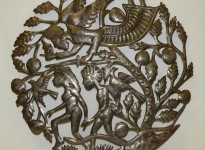
The DECORATIVE METAL mostly comes mianlyfrom one neighborhood in Haiti—Croix-des-Bouquets- which is about a ½-hour drive from Port-au-Prince to the northeast. The small, vibrant community is both home and work space to about three dozen metal artists and many of their families.
The metal comes from used oil drums bought at the Port-au-Prince docks. Requiring intense labor, every drum must be cleaned of all oil residues and flattened. Each artist draws his design on the steel with chalk. Then the piece is hand cut, using hammer and chisel. It takes many steps and many hours to make a single piece of art. Some people prefer the natural steel color. Others love the bright-painted designs embellishing the raw steel.
There may come a time when there is a shortage of these drums as the world turns to new ways and new material for shipping oil. Heavy plastic is already being used to ship crude.
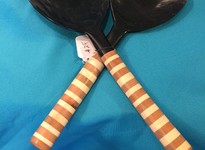
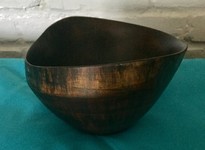
WOOD - Most of the deforestation in Haiti started many decades ago and is attributed today, in large part, to the charcoal trade. Much of the WOOD sold through Haiti’s Back Porch is obeche wood, artfully carved and finished into stunning bowls and trays by Einstein Albert (with a 14 step process), whose father before him, David Auld, created beauty from Haiti’s native wood. The obeche is a fast growing tree, mostly unsuitable for charcoal. Some years ago Einstein Albert was given a track of forest so he will have wood to make his bowls for generations to come. The other native wood Haitian artists use is mahogany.
CARVED STONE - from the rocks found in the rivers and streams of Haiti. Commonly called River Stone, it's soft, like soap stone. Each piece is unique, all hand carved and polished.
BOOKS - are available for purchase by contacting [email protected]. Flat $4.00 shipping fee will be added.
Paper Mache (Papier mâché) - a mixture of heated paper, glue, water and flour - is a multilayered process used to make art objects as well as usable household items. It comes mostly from the southern city of Jacmel and is one of the signature crafts of Haiti.