


Bri kouri, nouvèl gaye.
Noise runs, news spreads.
Haiti - Humanitarian : Emergency Operation to assist 1 million Haitians
19/04/2016 10:16:49
 |
 |
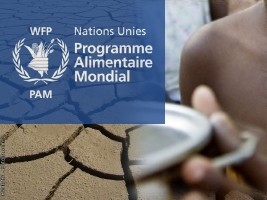
The United Nations World Food Programme (WFP) will launch an emergency operation to assist 1 million people devastated by three years of prolonged drought exacerbated by the El Niño weather phenomenon.
An estimated 3.6 million people, or one-third of Haiti’s population, face food insecurity. This number includes more than 1.5 million who are severely food insecure and do not know where their next meal is coming from, according to an assessment by WFP and the National Coordination for Food Security.
"We must immediately help hungry Haitians. Drought and poverty should not force a child to go to bed hungry," said WFP Executive Director Ertharin Cousin, ending a three-day visit to Haiti where she met communities hit by drought and El Niño.
The assessment found that the main 2015 spring harvest was below average, with almost three-quarters of farmers reporting they had lost more than 82% of production. For the 2016 spring season, 65% of families said they could not plant due to a lack of agricultural inputs. A scarcity of locally produced food has led to price hikes of up to 60%.
"We can help save lives and livelihoods now. We must work with the government, local communities and other partners, on longer-term asset development and climate smart agriculture programmes," Cousin said. "Poor Haitian farmers living in vulnerable places must have the capacity to endure future climate-related disasters. Working together we will begin building a future with zero hunger."
WFP initially responded with food distributions in Haiti for a two-month period to 120,000 people. With the new emergency operation this week, WFP will assist the 1 million people as Haiti enters the lean season from March to June when food stocks from the previous year run out.
Some 700,000 people in Haiti will receive cash transfers, which will provide the poorest and most vulnerable with the ability to purchase food while at the same time strengthening local economies. Another 300,000 people will be given a mix of cash transfers and food.
In a second phase, 200,000 people will receive food to work on watershed management and soil conservation projects, creating assets to help communities to plant small vegetable gardens. WFP plans to assist pregnant and breastfeeding women and young children with a specialized blended cereal fortified with vitamins and minerals to prevent malnutrition.
HL/ HaitiLibre
Frustration Haunts Haitian Priest
Publication: The Day, New London, CT
Food and life. Many people perhaps take them for granted.
But for Johnson, a priest in Les Palmes, Haiti, those two words have profound significance. He survived the 2010 earthquake that killed more than 300,000 people and devastated the already impoverished country.
"Before the earthquake, life was already difficult," Johnson said Thursday through translator Degaule Morisset. "Life after the earthquake got even harder. The little resources we had were strained even more because people from Port-au-Prince were looking for help."
Les Palmes is a rural mountain village with a population of about 30,000. It has no running water and electricity is limited to the few buildings with access to solar panels.
Thirty residents of Les Palmes, Johnson said, were confirmed dead and dozens more were unaccounted for after the quake.
Vil was in Groton recently to visit his sister, who lives in town. He shared lunch with friends from the Diocese of Norwich Outreach to Haiti and St. Mary Church in Coventry and with Anthony Calhoun, who will travel to the village in October with DOCARE, a medical outreach organization.
These organizations, Johnson said, were instrumental in the village's survival long before the quake.
Johnson said he was in the rectory when the earthquake hit. Outside his window, he could see his beloved church crumbling to the ground.
"It was hard to think as it was happening," Johnson said as his eyes widened. "I still try not to think about it."
Immediately after the quake, he said, he held a funeral and burial for 15 villagers to prevent the spread of disease. He had to set priorities for who needed help immediately and who would have to wait for assistance. Aid workers didn't reach the village for about a week.
People were in shock, Johnson said, as many of their homes were reduced to rubble. Many are still living in tents.
"It's very frustrating for me to tell people that I can't help them," Vil said. "There just aren't enough resources."
Johnson said his main priorities now are building permanent homes, rebuilding the church and re-establishing the agricultural industry.
Anna DeBiasi, the development director of Outreach to Haiti, said the survivors immediately turned to Vil for guidance. "There really is no local government," she said. "He's the unofficial mayor. He's the go-to guy. He settles neighbor disputes and distributes aide."
Outreach to Haiti supports orphanages, primary care clinics and neighborhood meal programs. It "twins," or partners, parishes here with villages in Haiti.
Barbara Charland and Lou Friedrich, parishioners at St. Mary, said they were compelled both for moral and social reasons to help with the Haitian ministry at the church, which raises money to support the secondary school, teachers' salaries and student scholarships. They started a sewing and carpentry program.
When Johnson returns to Les Palmes later this month, he will find waiting there seven 55-gallon drums filled with necessities that St. Mary sent.
"How can you not help the people in Haiti?" Friedrich said. "There is just so much need."
Charland said she first went to Haiti in 1999 and was bitten by the "good Haitian bug." She has been helping ever since but was not in the country when the earthquake hit.
"When people learned that I was going, they would tell me, 'Be careful of this or be careful of that,' but what I learned is that people are people no matter where you go. If people need help, you have to help them."
After the earthquake, Johnson said, the will of the people grew stronger and more resilient.
"They became more spiritual," he said. "They thought, 'If I didn't die, it was because God wanted me to live.' Their faith grew and got stronger."
